


E-invoicing from 2027: prepare SAP Business One correctly
E-bill: Secure until 2027, efficient from today.
E-invoicing is becoming mandatory in many places – and is also a great opportunity to sustainably improve financial and business processes. There is currently uncertainty in many companies: Is a PDF invoice sufficient? Which formats are really permissible? And how can the changeover be sensibly integrated into existing processes without creating new isolated solutions?
This is exactly where ANG comes in. We support companies in implementing e-invoicing in a legally compliant, practical and future-proof manner – embedded in functioning processes and systems. Our focus is not on theoretical compliance, but on stable processes, less manual effort and measurable benefits in day-to-day business.
Different duties, same challenges.
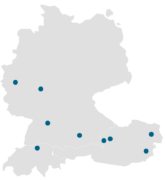
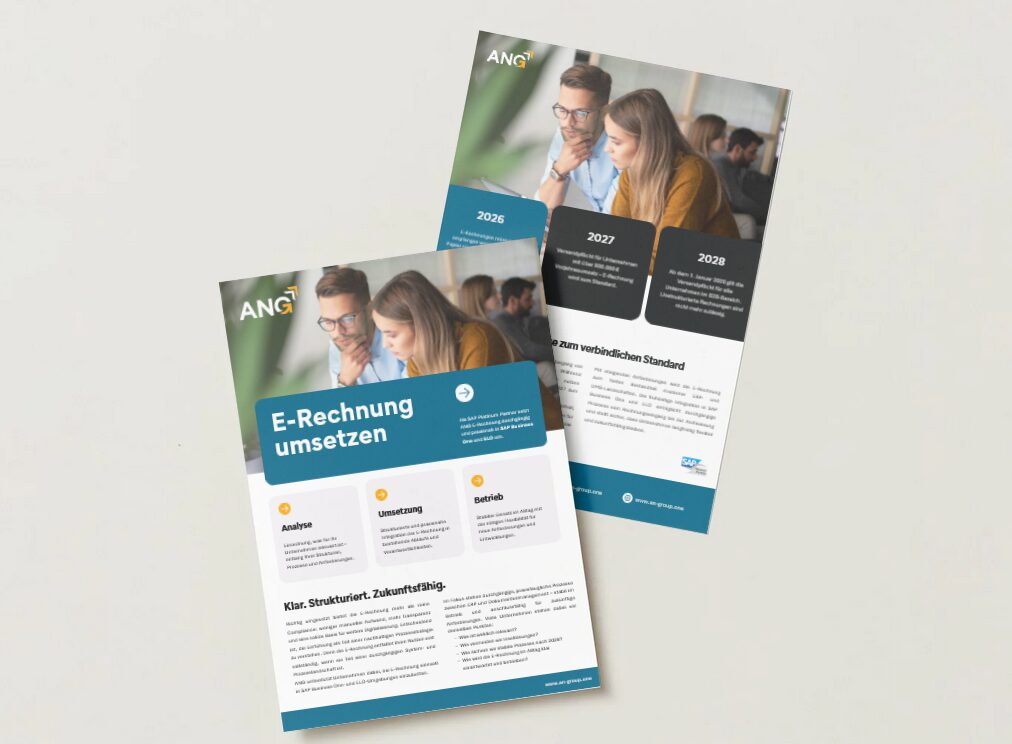
What applies from when - legal obligations at a glance
🇩🇪 Germany
- Obligation to receive e-invoices since 01.01.2025
- PDF invoices do not count as e-invoices
- Obligation to issue in B2B from 2027, for all companies without exception from 2028
- Only EN-16931-compliant formats (XRechnung, ZUGFeRD) permitted
🇦🇹 Austria
- E-billing established as mandatory in B2G
- No B2B obligation, but increasing standard
- E-invoicing obligation applies to German permanent establishment
- EU requirements (ViDA) increase the pressure to act
- Early introduction avoids later changes
🇨🇭 Switzerland
- QR-bill as standard, but no structured e-bill
- E-billing established in the public sector
- No B2B obligation, but widespread use
- Particularly relevant for EU and DACH business
🌍 International
- Global change towards mandatory e-invoicing
- Europe sets the standard with EN 16931 and ViDA
- PDF invoices are no longer sustainable internationally
- Critical for companies with EU business
- Basis for future notification and reporting obligations
E-billing is more than a legal obligation
Why a PDF invoice is not an e-invoice
Many companies already work with digital invoices – usually in the form of PDFs. However, what appears modern at first glance does not meet the requirements of the coming years. In future, the decisive factor will no longer be whether an invoice is sent digitally, but whether it is structured, machine-readable and can be processed automatically. With the Europe-wide transition to e-invoicing, PDF-based processes are increasingly losing their legal and operational significance.
A genuine e-invoice is based on standardized data formats in accordance with EU standard EN 16931, such as XRechnung or ZUGFeRD. These invoices can be checked and validated directly in the system and processed without media breaks. The result: less manual effort, lower error rates, shorter processing times and significantly higher data quality – across purchasing, accounting and sales.
Legally compliant. Consistent. Future-proof.
The e-invoicing process - end-to-end thinking

Structured invoices directly from the SAP debiting process
In SAP Business One, invoices are already created today on the basis of cleanly maintained master data, tax keys, price lists and document links. It is precisely this structure that is the prerequisite for a genuine e-invoice.
With ANG Digital Invoice, the outgoing invoice is generated directly from the SAP authoring process as a structured e-invoice. Instead of just outputting a PDF layout, SAP Business One uses the existing document data to create a standard-compliant format such as XRechnung or ZUGFeRD. Users continue to work in the familiar SAP dialog – the e-invoice logic runs in the background.
SAP Business One possibilities in interaction:
SAP Business One provides all relevant invoice information in a structured manner – including tax rates, item logic, payment terms and references. This allows e-invoices to be generated that are not only formally correct, but can also be processed fully automatically.
✔️ Sales and accounting retain their standard process, while the company invoices in a legally compliant and future-proof manner – without additional tools or manual conversion.

Send outgoing invoices legally compliant and automatically
Invoice receipt is one of the most complex areas in financial accounting. SAP Business One offers clear accounts payable processes for this – parked invoices, approvals, document references and posting logic. ANG ensures that structured e-invoices arrive here seamlessly.
Incoming structured invoices are recognized and read with ANG Digital Invoice. The ELO Engine takes over the audit-proof filing and transfers the invoice to SAP Business One as a parked incoming invoice. The rest of the approval process takes place entirely in the SAP standard.
SAP Business One options in interaction:
Parked documents, approval-relevant fields, cost centers, projects and company codes remain fully usable. Departments check in the familiar SAP workflow – instead of in external systems.
✔️ Significantly less manual data entry, clear responsibilities and complete transparency about the status of each invoice.

Legally compliant e-invoicing with XRechnung and ZUGFeRD
A medium-sized company creates invoices from SAP Business One on a daily basis. Previously, these were sent as PDFs – manually generated, sent and sometimes post-processed. With ANG, invoices are created directly from the SAP Business One customer process as legally compliant e-invoices in accordance with EN 16931. Depending on the recipient requirements, the XRechnung or ZUGFeRD formats are used. Both formats are based on structured XML data and enable fully automated, electronic processing without media disruptions:
- XRechnung as a pure, structured XML format for authorities and platforms
- ZUGFeRD as a hybrid format with XML data and additional PDF view for business partners
The invoice format is automatically set up correctly, checked and transmitted electronically to customers or platforms – without manual post-processing.
Result:
Legally compliant outgoing invoices without additional effort, fewer manual steps and a clean database for customers and subsequent processes.
Validation and reconciliation - using SAP logic consistently
A major advantage of structured e-invoices is the ability to check invoice data in the system. SAP Business One already offers all the relevant comparison data for this: Prices, quantities, document references, purchase orders and goods receipts.
With ANG Digital Invoice, this information is used to automatically reconcile invoices. Discrepancies between the invoice and order become visible before they are approved or posted. The focus shifts from manual checks to targeted checking of exceptions.
SAP Business One possibilities in interaction:
Document links, references to purchasing documents and structured item data enable consistent reconciliation – directly in the ERP.
✔️ Fewer errors, lower audit risk and faster approvals with consistent control

EDI invoice exchange - scalable expansion of SAP processes
SAP Business One is ideally suited as a central ERP, but quickly reaches its limits with classic EDI without an extension. The ANG EDI Engine specifically supplements SAP Business One with structured exchange processes with business partners.
Documents such as INVOIC or ORDERS are automatically generated, transferred and processed – embedded in the existing SAP process logic and coordinated with existing master data and document types.
SAP Business One possibilities in interaction:
Centralized maintenance of business partners, articles and prices ensures that EDI documents remain consistent and maintainable – even with increasing volumes.
✔️ Stable partner processes without media disruptions and a solution that grows with the company.

Further processing and booking - deliberately in the SAP standard
After checking and approval, the booking is made entirely in SAP Business One. Existing approval and posting workflows are retained and are not replaced by external systems.
SAP Business One options in interaction:
Automatic posting, cost center assignment, project assignment and closing logic remain consistent – even with increasing invoice volumes.
✔️ Clear responsibilities, maintainable processes and clean monthly and annual financial statements.

Archiving - documents structured, audit-proof and linked
A medium-sized company creates invoices from SAP Business One on a daily basis. Previously, these were sent as PDFs – manually generated, sent and sometimes post-processed.
With ANG, invoices are generated directly from the SAP debiting process as structured e-invoices (XRechnung or ZUGFeRD). The format is automatically set up correctly, checked and transmitted to customers or platforms.
What SAP Business One makes possible here:
Clear assignment of posting, business partner and original document – cross-system and consistent.
Added value:
Security during audits and company audits as well as transparent proof from document to posting.
Why companies rely on SAP Business One and ANG
Safe
Legally compliant e-invoices are created directly from the structured data of SAP Business One. ANG ensures that formats, mandatory fields and tax requirements are reliably fulfilled - in line with European standards and national requirements.
Global
SAP Business One forms the central basis for standardized e-invoicing processes across national borders. ANG takes regional particularities into account without creating isolated solutions or parallel processes.
Reliable
Consistent, automated workflows from creation to posting ensure stable processes on a daily basis. Checks and workflows noticeably reduce errors and manual effort.
Effective
Structured e-invoices enable real automation: less manual entry, faster processing times and a noticeable reduction in the workload of finance teams - while at the same time improving data quality.
One process. All invoices.
A consistent process for all invoice formats
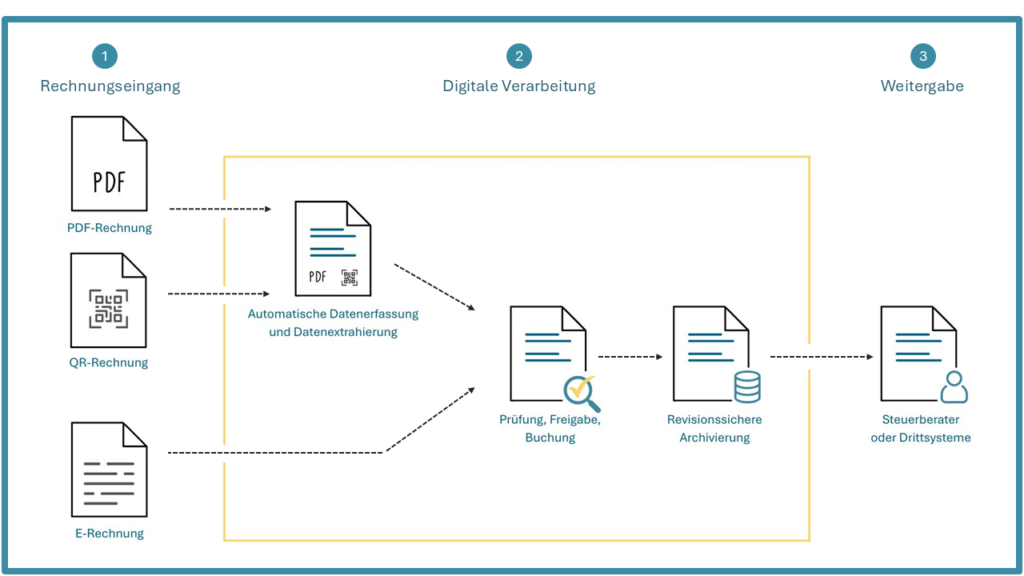
Structured processing of e-invoices – regardless of the invoice format
Integration, control and future-proofing
Safe until 2027, efficient from today.
Expand your knowledge of electronic invoicing
Optimize processes, automate workflows and get more out of your system.
Solution Guide
Implementing e-billing - from an obligation to a stable process

Webinar recording
Switching to electronic invoicing - why and how?
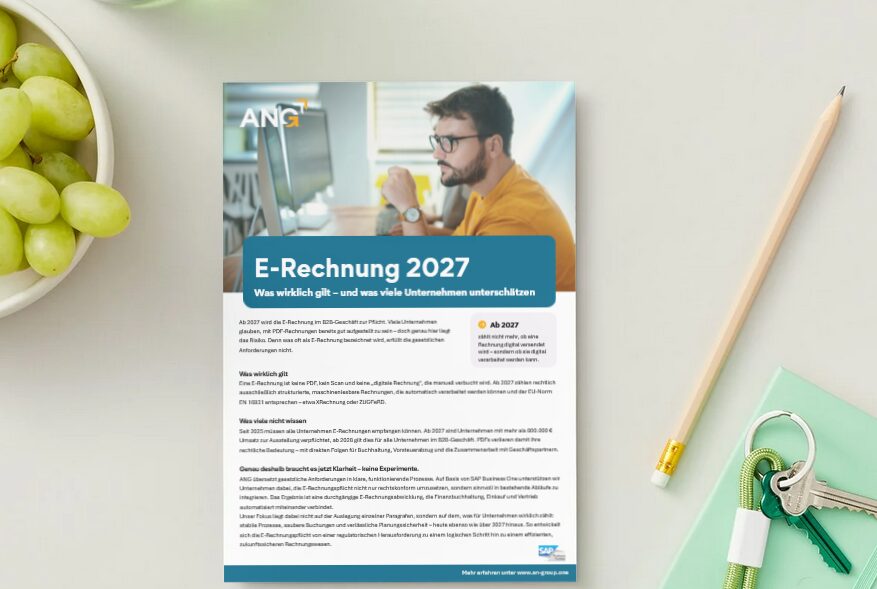
Factsheet
What really applies - and what many companies underestimate

🇨🇭 Focus Switzerland
ANG incoming invoice CH - automated directly in SAP
Let's talk about your e-invoicing strategy
- which specific requirements apply to your company,
- how well your existing SAP processes are prepared,
- and which next step makes sense – technically and organizationally.