
Skip to content
ANG | SAP Platinum Logo
When Automation Thinks for Itself

Workflow Automation with AI

Forwarding approvals, transferring data, reviewing documents, or compiling information from various systems: In many companies, business processes consist of numerous recurring steps. Traditional workflows can already automate a large portion of these. But what happens when processes don’t always follow the same pattern?

This is where artificial intelligence comes into play. It extends traditional automation by adding the ability to analyze information, understand content, and prepare decisions. This makes it possible to design even more complex processes more efficiently.

What does workflow automation with AI mean?

In traditional workflow automation, processes are executed based on predefined rules. A document is received, assigned to a person, reviewed, and then forwarded to the next step in the process.
AI expands on this approach. For example, it can capture the content of a document, categorize a request, or filter out relevant information from unstructured data. The workflow then uses these insights to automatically initiate the appropriate next step.
Simply put: Traditional automation executes processes. AI helps to understand and evaluate information within these processes.
It is precisely the combination of these two approaches that opens up new possibilities for companies to achieve seamless and intelligent workflows.
ANG | Businessman thinking at a computer
Recognize

AI identifies relevant information in documents, emails, or other data sources.

Analyze

Information is organized, connections are identified, or content is categorized.

Trigger

Based on the available information, the next step in the process is initiated.

Further Processing

Data is transferred to connected systems or the appropriate individuals.

Workflow Automation with Real Added Value

Where AI-powered workflows are particularly interesting

Opportunities for intelligent workflows can be found in nearly every area of a business. Processes in which information must first be processed or evaluated before the next step can be taken are particularly interesting.
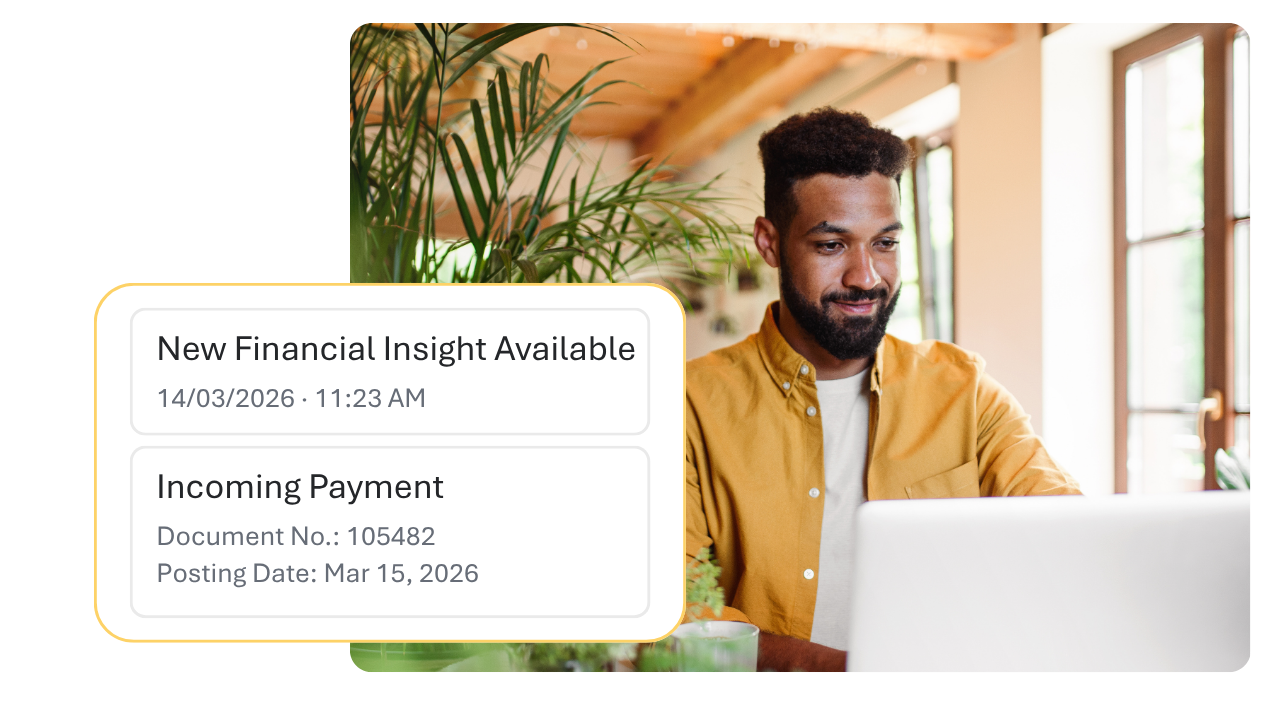

From Information to Action

The key advantage of AI-powered workflows is that information is not only analyzed but can also be integrated directly into existing business processes.

For example, instead of manually opening an incoming document, extracting relevant information, and then transferring it to another system, individual steps can be linked together:

Gather information → Analyze content → Prepare a decision → Initiate the process → Provide the result

Employees then step in primarily in situations where their experience, professional judgment, or approval is actually required.
ANG | Female manager involved in budget analysis and strategy development
ANG | Woman in a yellow blazer at her laptop

SAP Business One as a Central Database

Workflow automation becomes particularly interesting when it is integrated with existing enterprise systems. SAP Business One supports key business processes such as finance, purchasing, sales, inventory management, and production.

When AI and automation are integrated with the ERP system, information can be fed directly into existing business processes. Instead of isolated, standalone solutions, this creates end-to-end workflows where data is centrally available and specific process steps can be automated.

The advantage: AI does not become an additional siloed system but rather provides support right where employees are already working every day.

Which workflows are best for getting started?

Not every process needs to be automated using AI right away. To get started, it’s a good idea to look for workflows that are time-consuming and, at the same time, have sufficiently repetitive patterns.

The Workflow Check:

The more often these questions are answered with “Yes,” the more worthwhile it is to take a closer look at the respective workflow.
ANG | ANG Image Asset 103
Conclusion

Automate where it really lightens the load

AI-powered workflow automation does not mean handing over decision-making entirely to technology. It’s about providing intelligent support for recurring tasks and getting information to the right place faster.
This enables companies to reduce manual steps, accelerate processes, and relieve employees of time-consuming routines.

Especially when combined with a centralized ERP solution such as SAP Business One, this creates the foundation for end-to-end processes in which data, AI, and automation work together effectively.

The goal is not to automate every process, but rather to automate precisely those steps where automation creates real added value.

ANG | AdobeStock 604623669

Where does your company have the greatest potential for AI?

Every company has processes with potential for automation. The challenge isn’t simply implementing any AI, but identifying the right use cases.

Let’s work together to find out where AI can save time, streamline processes, and lighten the workload for employees in your company.

From Concept to Implementation

Would you like to know where AI can bring you the greatest benefits?

Visit our AI & Processes section and discover specific use cases, real-world examples, and opportunities for your business. After all, the most exciting AI projects don’t start with a tool—they start with a process.
The World of AI Processes
Discover AI Across Your Processes
Learn how artificial intelligence can be used in areas such as finance, procurement, sales, logistics, and manufacturing.
SAP Business One
Use AI directly in ERP
Use AI strategically within SAP Business One to analyze data more effectively, automate processes, and make informed decisions faster.
AI Explained in Simple Terms
ANG AI Breaks
Concise, practical, and immediately actionable: Our AI Breaks showcase the latest technologies, trends, and applications for small and medium-sized businesses.
From Concept to Implementation
Your Partner for Getting Started with AI
Not every AI solution is right for every company. We help you evaluate opportunities, set priorities, and turn ideas into concrete projects.